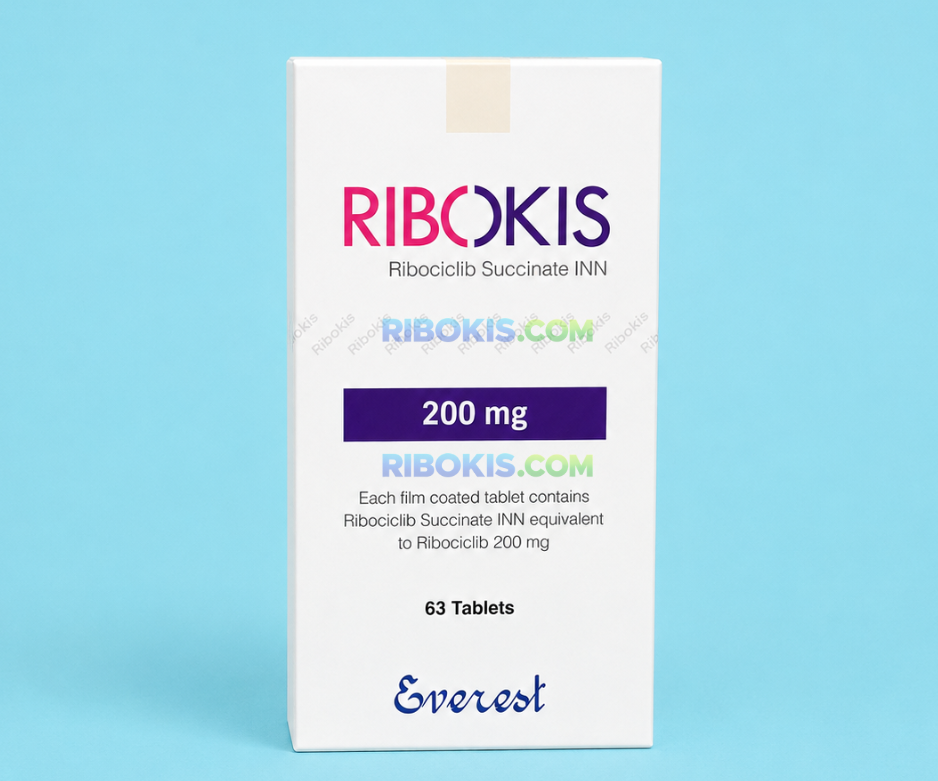
Ribokis 200 mg (Ribociclib)
Disclaimer: Before purchasing any medicine, always verify whether there is a valid drug license.
Ribokis 200 mg is identified for this website as a product containing ribociclib 200 mg, an oral anticancer medicine belonging to the cyclin-dependent kinase 4 and 6 (CDK4/6) inhibitor class. Product-specific information about the Ribokis manufacturer, marketing authorization holder, country of registration, packaging and regulatory status should be verified against the actual product documentation before publication.
Ribociclib is used with endocrine therapy for selected patients with hormone receptor-positive (HR-positive), human epidermal growth factor receptor 2-negative (HER2-negative) breast cancer. Depending on the regulatory jurisdiction and treatment setting, ribociclib may be used in certain early, advanced or metastatic breast-cancer populations.
The established reference brand for ribociclib is KISQALI, developed by Novartis under a research collaboration with Astex Pharmaceuticals. Ribociclib was developed through this collaboration, and KISQALI received its initial U.S. approval in 2017. Ribokis should not automatically be described as KISQALI or as an identical product because the manufacturer, formulation, excipients, packaging and authorization pathway may differ.
Everest Pharmaceuticals Ltd. About the Manufacturer
Everest Pharmaceuticals Ltd. is a pharmaceutical manufacturer based in Bangladesh. The company is involved in the development, production, and marketing of pharmaceutical products, including medicines used in specialized therapeutic areas.
Everest Pharmaceuticals focuses on manufacturing quality medicines for the healthcare market and offers a range of products, including treatments used in oncology and other medical fields. Its product portfolio includes various generic medicines formulated for patients and healthcare providers.
Company Name: Everest Pharmaceuticals Ltd.
Industry: Pharmaceutical Manufacturing
Country: Bangladesh
Business Activities: Manufacturing, marketing, and distribution of pharmaceutical products
Product Areas: Includes specialized and general pharmaceutical medicines
Quality Focus: Product manufacturing and quality-control processes are intended to support medicine quality, safety, and regulatory compliance.
For product-specific information, it is important to check the official packaging, product insert, batch details, and manufacturer information, as formulations and regulatory status may vary by product and market.
Head Office: Everest Pharmaceuticals Ltd. is located at Rahman’s Regnum Centre (10th & 11th floor), 191/1 Tejgaon Commercial Area, Dhaka-1208, Bangladesh.
Manufacturing Plant: Everest Pharmaceuticals Limited B-33, 45 & 46, BSCIC, Kanchpur, Narayanganj–1430, Bangladesh.
Ribokis 200 mg (Ribociclib) is manufactured by Everest Pharmaceuticals Ltd., a pharmaceutical company based in Bangladesh. Available product information identifies Everest Pharmaceuticals as the manufacturer of Ribokis 200 mg tablets. Ribokis contains ribociclib, a CDK4/6 inhibitor used as part of treatment for certain hormone receptor-positive, HER2-negative breast cancers. Because Ribokis is a prescription oncology medicine, it should be used only under appropriate medical supervision.
| Topic | Information |
|---|---|
| Product name | Ribokis |
| Active ingredient | Ribociclib |
| Stated strength | 200 mg |
| Dosage form | Product-specific information requires verification |
| Route of administration | Oral, subject to product documentation |
| Drug class | Cyclin-dependent kinase 4/6 inhibitor |
| Therapeutic category | Antineoplastic medicine |
| Reference product | KISQALI |
| Reference-product developer | Novartis, under collaboration with Astex Pharmaceuticals |
| Initial U.S. approval of reference product | 2017 |
| Ribokis manufacturer | Everest Pharmaceuticals Ltd. |
What Is Ribociclib?
Ribociclib is an oral targeted anticancer medicine that selectively inhibits CDK4 and CDK6. These enzymes help regulate progression through the cell cycle.
In HR-positive breast cancer, signaling through cyclin D and CDK4/6 contributes to phosphorylation of the retinoblastoma protein and progression of cells from the G1 phase toward DNA synthesis. By inhibiting CDK4/6 activity, ribociclib can interfere with this process and reduce proliferation of susceptible cancer cells.
Ribociclib is generally used as part of a treatment regimen that also targets hormone signaling, rather than as a conventional cytotoxic chemotherapy medicine.
What Is Ribokis 200 mg Used For?
The therapeutic use of Ribokis depends on the approved indication for the specific product and the applicable country’s regulatory requirements.
Ribociclib is used in selected patients with HR-positive/HER2-negative breast cancer, including certain:
- Stage II or III early breast cancers with an elevated risk of recurrence.
- Advanced breast cancers.
- Metastatic breast cancers.
Depending on the treatment setting, ribociclib may be combined with an aromatase inhibitor or fulvestrant.
In premenopausal or perimenopausal women, and in appropriate male patients when required by the applicable treatment regimen, endocrine therapy may be accompanied by ovarian-function suppression with an LHRH agonist.
The precise approved population, combination treatment and treatment duration can differ between jurisdictions. The official prescribing information applicable to the patient should therefore be followed.
How Does Ribociclib Work?
Ribociclib selectively inhibits cyclin-dependent kinases 4 and 6.
CDK4 and CDK6 are important regulators of the cell cycle. Their activity contributes to phosphorylation of the retinoblastoma protein, allowing cells to progress through the G1 phase toward the S phase, where DNA synthesis occurs.
By blocking CDK4/6 activity, ribociclib can:
- Reduce phosphorylation of retinoblastoma protein.
- Slow progression through the cell cycle.
- Reduce proliferation of susceptible tumor cells.
- Complement endocrine therapy in hormone receptor-positive breast cancer.
This mechanism makes ribociclib a targeted cell-cycle inhibitor rather than a traditional nonspecific cytotoxic chemotherapy.
Ribociclib and Endocrine Therapy
Ribociclib is commonly incorporated into endocrine-based treatment because HR-positive breast cancers can depend on estrogen-receptor signaling as well as cell-cycle pathways.
Depending on the indication, ribociclib may be combined with an aromatase inhibitor or fulvestrant. The combination aims to inhibit complementary mechanisms involved in tumor growth.
The appropriate endocrine partner and treatment schedule depend on the disease setting, patient’s menopausal status and applicable prescribing information.
Ribokis 200 mg Strength
A 200 mg strength refers to the stated amount of ribociclib contained in the dosage unit.
The 200 mg strength should not be interpreted as the standard total daily dose for every patient. Ribociclib dosing can involve multiple tablets and a defined treatment cycle, and the prescribed regimen depends on the indication and treatment combination.
The current reference-product labeling uses a higher total daily dose for many adult treatment regimens and incorporates dose reductions when clinically necessary. Therefore, a 200 mg tablet can be used as part of a prescribed regimen without implying that every patient should take one 200 mg tablet daily.
The exact dosage form and composition of Ribokis 200 mg should be confirmed from its actual packaging and product documentation.
General Administration Principles
Ribociclib is administered orally according to the prescribed treatment schedule.
General principles include:
- Take ribociclib exactly as prescribed.
- Follow the specified treatment cycle.
- Take doses at approximately the same time each day.
- Tablets should be handled according to the official product instructions.
- Do not change the dose without the treating healthcare professional’s direction.
- Do not stop treatment without discussing it with the treatment team.
- Follow the applicable instructions for missed or vomited doses.
Because dosing schedules and missed-dose instructions can be product- and jurisdiction-specific, patients should rely on their prescription and official product information.
Treatment Cycles
Ribociclib is commonly administered in treatment cycles that include a period of daily treatment followed by a treatment-free interval.
For many established regimens, treatment follows a 21-days-on and 7-days-off cycle. This schedule allows a planned treatment interruption before the next cycle.
However, treatment duration and schedule can vary according to the indication and combination therapy. Patients should not modify the cycle independently.
Dose Modifications
Dose interruptions and reductions may be required when clinically significant adverse reactions occur.
Dose modification can be particularly relevant for:
- Neutropenia.
- Liver-function abnormalities.
- QT-interval prolongation.
- Other clinically significant toxicities.
- Drug interactions.
The appropriate reduced dose depends on the indication, treatment combination and specific adverse reaction.
Important Safety Information
Ribociclib has clinically important safety considerations. Important risks associated with ribociclib include:
- Neutropenia
- Hepatotoxicity
- QT-interval prolongation
- Interstitial lung disease/pneumonitis
- Embryo-fetal toxicity
- Potential clinically significant drug interactions
Because ribociclib affects cell-cycle activity and can also influence cardiac repolarization and hepatic function, appropriate monitoring is an important part of treatment.
Neutropenia
Neutropenia is one of the important adverse reactions associated with ribociclib.
A reduction in neutrophil counts can increase susceptibility to infection. Complete blood counts are therefore generally monitored during treatment.
Patients should promptly report symptoms such as fever or other signs of infection to their healthcare professional.
Dose interruption or reduction may be necessary when neutropenia reaches clinically significant severity.
QT-Interval Prolongation
Ribociclib can prolong the QT interval, which can increase the risk of potentially serious cardiac rhythm abnormalities in susceptible patients.
Healthcare professionals may evaluate:
- Electrocardiograms.
- Serum electrolytes.
- Concomitant medications.
- Cardiac risk factors.
Medicines known to prolong the QT interval should be reviewed carefully before and during treatment.
Hepatotoxicity
Ribociclib can cause abnormalities in liver function and clinically significant hepatotoxicity.
Liver-function testing is therefore an important component of monitoring. Abnormal liver-test results may require treatment interruption, dose reduction or discontinuation depending on severity and the applicable prescribing information.
Patients should inform their healthcare professional about symptoms that could indicate liver problems, including persistent nausea, unusual fatigue, abdominal discomfort, dark urine or yellowing of the skin or eyes.
Interstitial Lung Disease and Pneumonitis
Ribociclib has been associated with interstitial lung disease (ILD) and pneumonitis, which can potentially be serious.
Patients should report new or worsening:
- Cough.
- Shortness of breath.
- Difficulty breathing.
- Other unexplained respiratory symptoms.
Healthcare professionals should evaluate suspected pulmonary toxicity promptly.
Embryo-Fetal Toxicity
Ribociclib can cause fetal harm when administered during pregnancy.
Pregnancy status, contraception and reproductive considerations should be discussed with the treating healthcare professional before and during treatment as appropriate.
Patients who become pregnant while receiving ribociclib should contact their healthcare professional promptly.
Drug Interactions
Ribociclib is metabolized substantially through CYP3A pathways and can be affected by medicines that inhibit or induce CYP3A.
Strong CYP3A inhibitors may increase ribociclib exposure, while CYP3A inducers may decrease exposure and potentially reduce its effectiveness.
Ribociclib can also affect the handling of certain other medicines through CYP3A inhibition.
Particular caution is required with medicines that can prolong the QT interval.
Patients should provide their healthcare professional with a complete list of prescription medicines, over-the-counter medicines, vitamins and herbal products before starting treatment.
Common Adverse Reactions
Adverse reactions reported with ribociclib can include:
- Neutropenia.
- Leukopenia.
- Infections.
- Nausea.
- Fatigue.
- Diarrhea.
- Headache.
- Alopecia.
- Vomiting.
- Constipation.
- Decreased appetite.
- Liver-enzyme abnormalities.
- Back pain or other musculoskeletal symptoms.
The frequency and severity of adverse reactions can differ according to the treatment setting and combination regimen.
Monitoring During Ribociclib Treatment
Monitoring requirements may include:
Complete blood count
CBC testing helps identify neutropenia and other blood-count abnormalities.
Liver-function testing
Liver enzymes and other relevant laboratory parameters may be monitored to identify hepatotoxicity.
Electrocardiogram
ECG monitoring may be required because of the risk of QT-interval prolongation, particularly at treatment initiation and when clinically indicated.
Electrolytes
Electrolytes such as potassium, calcium, phosphorus and magnesium may require monitoring because abnormalities can contribute to cardiac risk.
Clinical assessment
Healthcare professionals may also assess symptoms suggesting infection, liver injury, pulmonary toxicity or other adverse reactions.
Ribociclib Reference Product: KISQALI
The established reference brand containing ribociclib is KISQALI.
KISQALI was developed by Novartis, with ribociclib’s development associated with a research collaboration involving Astex Pharmaceuticals. The product received its initial U.S. approval in 2017.
The reference product is important when describing the origin and regulatory history of ribociclib. However, the existence of a reference product does not establish that every later ribociclib product is manufactured by the same company.
Originator and First Development of Ribociclib
Ribociclib was developed through research involving Novartis and Astex Pharmaceuticals. Novartis became responsible for the development and commercialization of ribociclib as KISQALI.
Therefore, for website content, it is more accurate to distinguish between:
- Active ingredient: Ribociclib.
- Reference brand: KISQALI.
- Reference-product developer/commercial developer: Novartis, with development history involving Astex Pharmaceuticals.
- Specific Ribokis manufacturer: Requires product-specific verification.
The reference-product history should not be presented as proof of the manufacturer or authorization status of Ribokis.
Ribokis Versus KISQALI
Ribokis and KISQALI should not automatically be described as identical products merely because they contain ribociclib.
Products containing the same active pharmaceutical ingredient can differ in:
- Manufacturer.
- Marketing authorization holder.
- Manufacturing site.
- Excipients.
- Tablet characteristics.
- Packaging.
- Country-specific registration.
- Regulatory authorization pathway.
- Distribution and supply chain.
For this reason, the identity and regulatory status of Ribokis should be established from its own product documentation.
Everest Pharmaceuticals Ltd. Product Verification Process
To verify the authenticity of an Everest Pharmaceuticals product, follow the verification process below:
Scan the QR Code: Scan the QR code printed on the product box.
The QR code will direct you to the official product verification page.
Open the Box: After accessing the verification page, open the product box and locate the verification code printed on the bottle.
Submit the Verification Code: Enter the verification code from the bottle on the verification page and submit it to check the product’s authenticity.
Verification Success: If the verification is successful, the product is confirmed as legitimate.
Verification Error: If the system displays a verification error, the product may be counterfeit or unauthorized. Do not use the product until its authenticity has been confirmed through an appropriate official channel.
Counterfeit Products: If a product is confirmed to be fake, do not use or distribute it. Report the suspected counterfeit product and supplier to the appropriate regulatory authorities, such as the Directorate General of Drug Administration (DGDA) in World, and take appropriate legal action against the supplier through the relevant authorities.
Important: Always purchase medicines from licensed pharmacies or authorized suppliers and verify suspicious products before use.
Who Should Use Ribokis?
Ribociclib is a prescription anticancer medicine intended for use in appropriately selected patients under the supervision of a qualified healthcare professional.
Treatment suitability depends on factors including:
- Cancer type and stage.
- Hormone-receptor status.
- HER2 status.
- Previous treatment.
- Menopausal status where relevant.
- Blood counts.
- Liver function.
- Cardiac history.
- Concomitant medicines.
- Other individual clinical factors.
A healthcare professional should determine whether ribociclib is appropriate for a particular patient.
Medical Information Disclaimer
Ribokis 200 mg and ribociclib information on this website is provided for general educational purposes only. It does not replace official prescribing information, a physician’s assessment or individualized medical advice.
Do not start, stop, increase, decrease or otherwise change an anticancer medicine based solely on website information.
The manufacturer, authorization status, packaging, regulatory registration and other product-specific details of Ribokis 200 mg should be verified from authoritative product documentation before being presented as established facts.
Patients receiving ribociclib should follow the instructions provided by their oncology team and the official product information applicable to their country.
Daniel M.
Ribokis 200 mg was delivered in secure packaging, and the ordering process was straightforward. The product information provided was clear and helpful.
Sarah K.
I appreciated the detailed information about Ribokis and ribociclib before making an inquiry. The communication was professional, and my questions were answered clearly.
Michael R.
The Ribokis 200 mg information was easy to understand, especially the details about dosage, safety and monitoring. The overall service was smooth and professional.
Latest News
Hello world!
August 18, 2026 | by Ribokis
Welcome to WordPress. This is your first post. Edit or delete it, then start writing!
Read More →
FAQs
Ribociclib is a targeted anticancer medicine belonging to the CDK4/6 inhibitor class. It works by inhibiting cyclin-dependent kinases 4 and 6, which are involved in cell-cycle regulation.
Ribociclib is used with endocrine therapy in specified breast cancer settings because the treatments act on complementary pathways involved in tumor growth. The appropriate combination depends on the patient’s diagnosis and treatment plan.
HR-positive means the breast cancer cells have receptors for hormones such as estrogen or progesterone. HER2-negative means the cancer does not have excessive HER2 protein or gene amplification. These characteristics can help determine appropriate treatment options.
Ribociclib is a CDK4/6 inhibitor that targets cell-cycle signaling, while endocrine therapies act on hormone-related signaling pathways. They may be prescribed together for selected HR-positive breast cancers.
Blood tests can help monitor blood-cell counts and liver function during treatment. Ribociclib can cause changes in blood counts and liver enzymes, so monitoring helps healthcare professionals identify and manage treatment-related abnormalities.
Ribociclib can prolong the QT interval, which can affect the heart’s electrical rhythm. ECG monitoring may therefore be used to evaluate cardiac electrical activity before and during treatment according to the applicable prescribing information.
Grapefruit and grapefruit juice may affect CYP3A activity and can increase ribociclib exposure. Patients should discuss grapefruit products and other foods or supplements with their healthcare professional before using them during treatment.
Some herbal products can affect drug-metabolizing enzymes and may change ribociclib exposure. Tell your healthcare professional about all vitamins, supplements and herbal products before using them with ribociclib.
Fever can be important during ribociclib treatment because the medicine can cause neutropenia and increase infection risk. Contact your healthcare professional promptly if you develop a fever or other signs of infection.
Storage requirements should be followed according to the specific Ribokis product packaging and official product information. Keep the medicine in its original packaging and out of reach of children unless the product-specific instructions state otherwise.